
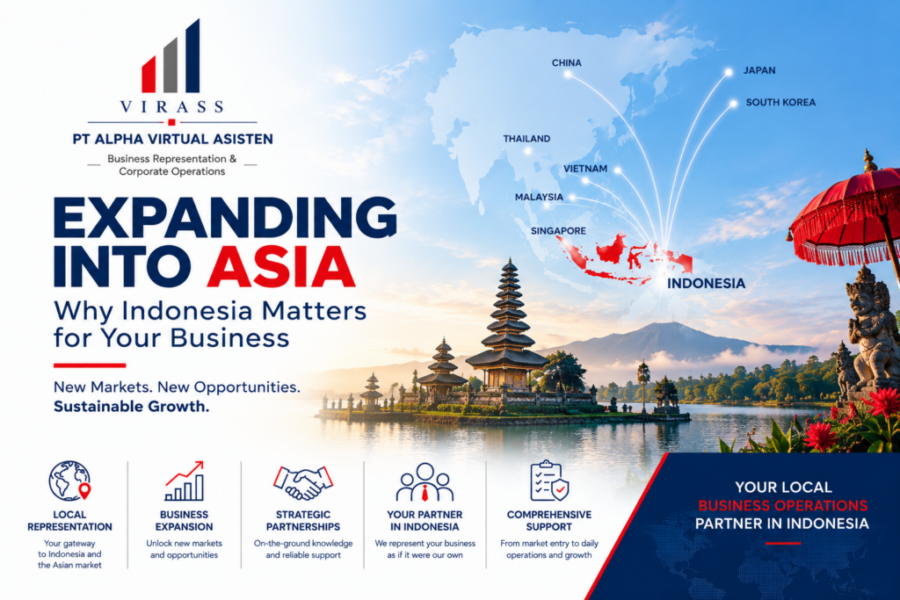
Expanding into Asia: Why Indonesia Matters for Your Business
Expanding into Asia: Why Indonesia Matters for Your Business
Asia Is Becoming More Connected
Asia continues to become increasingly important for companies looking to expand internationally. For businesses considering their next growth market, the question is no longer simply which country to enter, but how individual markets can fit into a broader regional strategy.
For companies looking to expand into Southeast Asia, Indonesia can play an important role in that strategy.
As Southeast Asia becomes increasingly interconnected through trade, investment and regional supply chains, companies entering the region need more than access to a new market. They need a practical understanding of local business environments, reliable coordination and the ability to manage operations on the ground.
Indonesia offers a combination of market scale, economic importance and regional connectivity that makes it relevant to companies developing a long-term presence in Asia.
Why Businesses Are Looking at Asia
Asia is home to some of the world’s largest and fastest-changing economies. For international businesses, the region offers opportunities across manufacturing, professional services, technology, consumer markets, infrastructure, digital businesses and many other sectors.
Southeast Asia is particularly relevant because its economies are increasingly connected through regional trade, investment and supply chains.
ASEAN attracted US$243.9 billion in foreign direct investment in 2025, representing a 9.7% increase from the previous year. The region accounted for approximately 15% of global FDI inflows, reinforcing its importance in the international investment landscape.
ASEAN’s current investment strategy also increasingly emphasizes the region as an integrated investment destination, with a focus on cross-border collaboration, integrated value chains and coordinated investment promotion.
For companies considering expansion into Asia, this means that entering one Southeast Asian market can increasingly be part of a broader regional strategy.
Why Indonesia Matters in an Asian Expansion Strategy
Indonesia should not be viewed only as another country on an expansion checklist.
It is Southeast Asia’s largest economy and one of the world’s largest population markets. The World Bank identifies Indonesia as Southeast Asia’s largest economy and ranks it 16th globally.
For companies looking at Asia, Indonesia can therefore offer two different opportunities.
Indonesia as a Market
Indonesia’s large domestic market can provide opportunities for companies seeking new customers, partnerships, suppliers and business relationships.
The country’s economic activity is supported by domestic demand, investment and services, while its long-term development strategy continues to focus on improving competitiveness, digitalization and investment.
Indonesia as Part of a Regional Strategy
For some companies, the objective may go beyond selling directly into Indonesia.
Indonesia can also form part of a broader Southeast Asian strategy involving regional suppliers, business partners, operational activities and market development.
This distinction is important.
Entering Indonesia does not necessarily mean abandoning a regional strategy.
Instead, Indonesia can become one component of a wider Asian expansion plan.
Expanding into Asia Requires More Than Market Research
One of the biggest mistakes companies can make when entering a new country is to focus entirely on the market opportunity.
Understanding market demand is important, but successful expansion also requires understanding how the business will actually operate locally.
A company considering expansion into Indonesia may need to think about:
- Local business structure
- Company establishment
- Local representation
- Business partners and suppliers
- Corporate administration
- Government and stakeholder communication
- Operational coordination
- Corporate documentation
- Governance and compliance
- Local professional advisers
- Ongoing management support
From Market Entry to Local Execution
A successful expansion strategy should not stop once a company enters a new market.
There are generally three stages that international companies need to consider:
Stage 1 — Enter
The company evaluates the market, develops its strategy and determines the appropriate structure for entering Indonesia.
Stage 2 — Establish
The company coordinates its local presence, documentation, business structure and other requirements with the appropriate professional providers.
Stage 3 — Operate and Grow
The company begins managing local operations, stakeholders, suppliers, documentation and ongoing corporate matters.
Why Business Representation Matters
For an international company without a full local management team, having a trusted business representative in Indonesia can provide an important connection between headquarters and local stakeholders.
Business representation can help create a reliable local point of contact for matters such as:
- Local business communication
- Stakeholder coordination
- Meeting coordination
- Supplier and vendor coordination
- Administrative follow-up
- Document follow-up
- Local operational coordination
- Communication with professional service providers
- Monitoring agreed business matters
Indonesia Expansion Is Not Only About Company Establishment
Company establishment is an important part of market entry, but it is only the beginning.
Once a business starts operating in Indonesia, management may need ongoing support with:
Coordinating day-to-day administrative and operational matters.
Providing a local point of contact between international management and Indonesian stakeholders.
Corporate Governance & Compliance
Helping organize corporate documentation, coordination and follow-up with relevant professional advisers.
Coordinating the establishment process with the appropriate notaries, advisers and other professional providers.
Indonesia as a Bridge Between International Strategy and Local Execution
For companies expanding into Asia, one of the most important questions is often: How do we make our international strategy work locally?
A company’s headquarters may have a clear regional strategy. However, local execution requires people who understand the local environment, communicate effectively with stakeholders and follow up on operational matters.
This is where the role of a local business partner becomes important.
The relationship can be viewed simply: International Management → Indonesia Operations → Local Stakeholders
A local business partner can help coordinate the connection between these three areas.
The result is greater visibility, clearer communication and more structured execution.
A Practical Framework for Expanding into Indonesia
Companies considering Indonesia as part of their Asian expansion strategy can use a simple five-step framework.
1. Assess
Understand the Indonesian market, business environment, competitors, opportunities and potential challenges.
2. Plan
Determine the appropriate business model, structure and operational requirements.
3. Establish
Coordinate the required company establishment, documentation and local arrangements with the appropriate professional providers.
4. Operate
Manage local communication, administration, suppliers, stakeholders and operational follow-up.
5. Grow
Develop the Indonesian business while maintaining appropriate corporate governance, operational visibility and long-term strategic alignment.
Why Local Support Can Make Asian Expansion More Effective
Expanding into a new country from overseas can create unnecessary complexity when management has to coordinate multiple local parties independently.
A local business partner can provide:
- One reliable point of contact
- Local representation
- Operational coordination
- Professional network
- International communication
- Flexible support
One Point of Contact
Instead of managing multiple local contacts separately, international management can have a central coordination point.
Local Representation
The company can have a trusted local representative supporting agreed business activities.
Operational Coordination
Local administrative and operational matters can be followed up more efficiently.
Professional Network
When specialized services are required, the local business partner can coordinate with the appropriate professional providers.
Internal Communication
International management often needs clear communication, structured updates and reliable follow-up.
Flexible Support
Not every company requires the same level of assistance. Support can be structured according to the company’s specific requirements.
Why Indonesia Can Be a Strategic Starting Point for Asian Expansion
For businesses considering expansion into Asia, there is no single strategy that works for every company.
Some businesses may prioritize Singapore. Others may focus on Vietnam, Thailand, Malaysia, Indonesia or another Asian market.
The right choice depends on the company’s industry, objectives, customers, supply chain, investment strategy and long-term plans.
However, Indonesia deserves consideration because of its economic scale, domestic market and strategic importance within Southeast Asia.
The World Bank projects Indonesia’s economic growth at approximately 5.0% in 2026, while emphasizing the importance of continued investment, productivity improvements and reforms that strengthen competitiveness and integration into global value chains.
For international companies, this creates an opportunity to think about Indonesia not simply as an individual market, but as part of a longer-term Asian growth strategy.
Choosing the Right Business Partner in Indonesia
The right local partner should be evaluated carefully.
Before engaging a business support provider, international companies should consider:
Does the partner understand international businesses?
Local knowledge is important, but the ability to communicate effectively with overseas management is equally important.
Can the partner provide one reliable point of contact?
A central coordination point can simplify communication and reduce unnecessary complexity.
Does the partner understand operational realities?
Entering a market is only the beginning. Ongoing execution matters just as much.
Can the partner coordinate with professional providers?
Legal, tax, accounting, notarial and other regulated matters should be handled by the appropriate professionals. A business support partner should understand its role and coordinate effectively with them.
Can the partner provide clear reporting and follow-up?
International management needs to know what has been completed, what remains outstanding and which matters require decisions.
The Role of VIRASS
VIRASS supports international companies that want to establish, manage and grow their business presence in Indonesia.
Our role is practical.
We act as a local business extension between international management and Indonesian stakeholders.
Our services include:
Local representation and coordination for international companies operating or expanding into Indonesia.
Corporate Operations Management
Support with ongoing administrative and operational coordination.
Project-based coordination of company establishment with the relevant professional service providers.
Corporate Governance & Compliance
Coordination and organizational support for corporate documentation, governance and compliance-related matters.
Looking Beyond Market Entry
Expanding into Asia is not simply about entering another country.
It is about building the right foundation for sustainable growth.
For some international companies, Indonesia may be the first step into Southeast Asia.
For others, it may become an important part of an existing regional strategy.
Whatever the approach, successful expansion requires more than a business opportunity.
It requires: Local understanding. Reliable representation. Effective coordination. Strong operational support. Clear communication. Long-term thinking.
Indonesia can offer significant opportunities for international companies looking toward Asia.
But turning those opportunities into sustainable business requires the right local execution.
Ready to Expand into Indonesia?
If your company is considering expanding into Asia and looking at Indonesia as part of its regional strategy, having the right local partner can make the process more structured and manageable.
VIRASS supports international companies with:
Business Representation
Corporate Operations Management
Company Establishment
Corporate Governance & Compliance
We help international businesses establish, coordinate, manage and grow their presence in Indonesia.
Your Trusted Business Partner in Indonesia.
Contact VIRASS to discuss your business expansion requirements.
Frequently Asked Questions
Is Indonesia a good market for Asian expansion?
Indonesia can be an important market for international companies because of its economic scale, domestic market and position within Southeast Asia. The suitability of Indonesia depends on the company’s industry, objectives and expansion strategy.
Can Indonesia be part of a broader Asian expansion strategy?
Yes. Companies can consider Indonesia as one component of a broader Southeast Asian or Asian expansion strategy, depending on their business model, supply chain, investment objectives and target markets.
Do foreign companies need a local business partner in Indonesia?
Not every company necessarily needs one. However, local representation and coordination can be useful for companies whose management teams are based overseas or do not yet have a full local operational team.
What does business representation in Indonesia involve?
Depending on the agreed scope, business representation can include local communication, stakeholder coordination, meeting coordination, vendor coordination, administrative follow-up and other agreed local business activities.
Does VIRASS provide legal or tax services?
No. VIRASS focuses on business representation, coordination and corporate support. Legal, tax, accounting and notarial matters are handled by the appropriate professional advisers.
Can VIRASS support a company after it has been established?
Yes. VIRASS provides ongoing support for areas such as business representation, corporate operations and corporate governance and compliance coordination, depending on the agreed scope of engagement.