
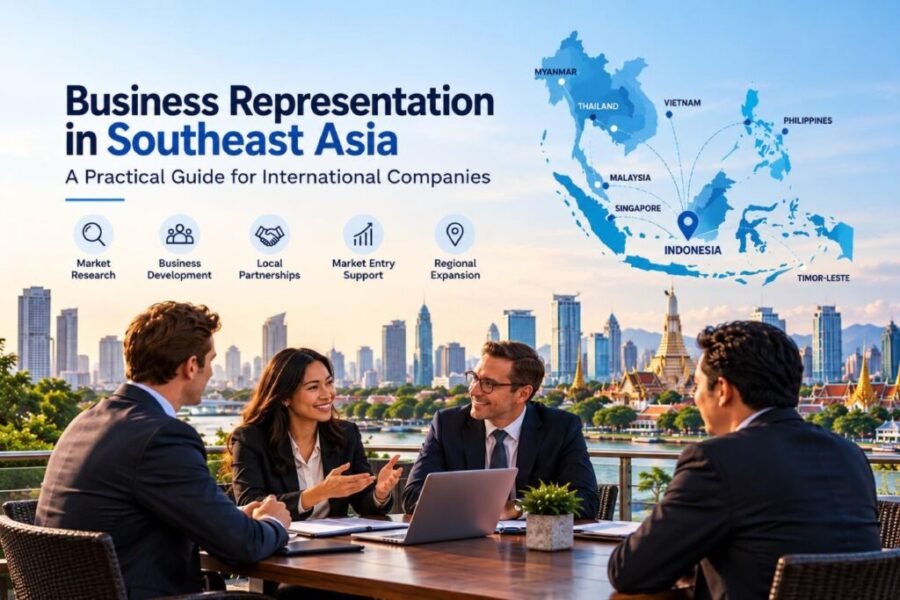
Business Representation in Southeast Asia: A Practical Guide for International Companies
Southeast Asia has become an increasingly important region for international companies looking to expand their business, develop new partnerships, and access growing markets.
The region offers a combination of large consumer markets, rapidly developing economies, established business hubs, and increasingly connected supply chains.
However, entering Southeast Asia is not as simple as choosing a country and starting to sell.
Each market has its own business environment, regulations, culture, commercial practices, and network of local stakeholders. For companies based outside the region, understanding these differences can be challenging without people on the ground.
This is where business representation in Southeast Asia can provide practical support.
A local business representative can help international companies understand the market, build relationships, coordinate local activities, and develop opportunities before committing to a larger local operation.
Why Southeast Asia Matters for International Companies
Southeast Asia consists of diverse markets with different levels of economic development and business maturity.
The region includes:
-
Indonesia
-
Singapore
-
Malaysia
-
Thailand
-
Vietnam
-
Philippines
-
Cambodia
-
Laos
-
Myanmar
-
Brunei
-
Timor-Leste
Together, these markets provide companies with access to a large and diverse regional economy.
For international businesses, opportunities can exist across sectors such as:
-
Technology
-
Professional services
-
Tourism and hospitality
-
Manufacturing
-
Consumer products
-
Digital businesses
-
Real estate
-
Education
-
Healthcare
-
Renewable energy
-
Logistics
-
Food and agriculture
However, regional opportunity does not mean that every market should be approached in exactly the same way.
Southeast Asia Is Not One Single Market
One of the most important considerations for companies entering Southeast Asia is that the region should not be treated as a single homogeneous market.
Singapore, Indonesia, Vietnam, Thailand, Malaysia, and the Philippines have different:
-
Regulatory environments
-
Languages
-
Business cultures
-
Consumer behaviors
-
Market structures
-
Costs
-
Tax systems
-
Government procedures
-
Distribution networks
A strategy that works in Singapore may not work in Indonesia.
Likewise, a business model that performs well in Indonesia may require significant adaptation before entering Vietnam or Thailand.
For this reason, international companies often benefit from combining a regional strategy with local execution.
What Is Business Representation in Southeast Asia?
Business representation means providing a local point of contact to support an international company’s activities within a target market.
The scope can vary depending on the company’s objectives.
A business representative may assist with:
-
Market research
-
Business development
-
Local stakeholder communication
-
Partner identification
-
Supplier coordination
-
Meeting arrangements
-
Project coordination
-
Market-entry preparation
-
Business introductions
-
Local administrative coordination
-
Follow-up activities
-
Reporting to overseas management
The representative does not necessarily replace the company’s management team or professional advisors.
Instead, the role is to create a practical bridge between the international company and the local market.
Why International Companies Use Local Representation
1. Local Knowledge
Online research can provide useful information about a market, but it cannot always explain how business is actually conducted locally.
A local representative can provide practical context about:
-
Business practices
-
Communication styles
-
Local expectations
-
Potential partners
-
Commercial relationships
-
Market conditions
This can help international management make better-informed decisions.
2. Local Business Relationships
Relationships are an important part of business development throughout Southeast Asia.
Companies entering a new market may need to identify and communicate with:
-
Potential customers
-
Distributors
-
Suppliers
-
Investors
-
Business partners
-
Service providers
-
Industry contacts
-
Local organizations
A local representative can help initiate and maintain these relationships.
3. Faster Local Communication
An international management team may be located several time zones away from the target market.
Having someone locally available can make communication and follow-up more efficient.
The representative can attend meetings, collect information, coordinate actions, and provide updates to the overseas team.
4. Lower Initial Commitment
Not every company is ready to establish a full local office.
A company may first want to:
-
Test market demand
-
Identify potential customers
-
Find partners
-
Understand local regulations
-
Validate a business model
-
Assess investment opportunities
Business representation can provide local support during this exploratory stage.
Indonesia as a Strategic Base for Southeast Asia
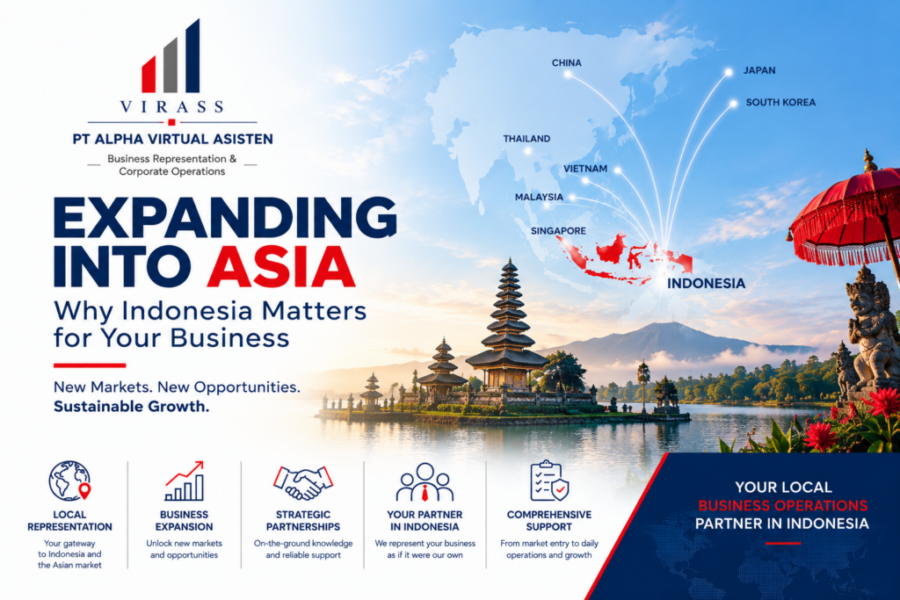
For companies exploring Southeast Asia, Indonesia can be an important market to consider.
Indonesia has a large domestic market and a significant role within the Southeast Asian economy.
Jakarta is also an important commercial center and a practical location for companies developing relationships across the region.
For some international companies, Indonesia may be the first market they explore before considering expansion into other Southeast Asian countries.
This does not mean Indonesia is automatically the right entry market for every company.
The appropriate market depends on factors such as:
-
Target customers
-
Industry
-
Business model
-
Investment requirements
-
Regulatory considerations
-
Distribution strategy
-
Operational requirements
A local business partner can help a company assess these factors before making a larger commitment.
From Indonesia to Southeast Asia
For companies using Indonesia as their first Southeast Asian market, the expansion process can be structured in stages.
Stage 1: Market Understanding
Begin by understanding the industry, target customers, competitors, regulations, and commercial environment.
Stage 2: Local Connections
Identify potential partners, customers, suppliers, and other relevant stakeholders.
Stage 3: Market Validation
Conduct meetings, gather feedback, and assess whether the commercial opportunity matches the company’s objectives.
Stage 4: Local Business Development
Develop relationships and begin building a pipeline of potential opportunities.
Stage 5: Regional Expansion
Once the company’s Indonesian activities are established, management can evaluate whether expansion into additional Southeast Asian markets makes sense.
This approach allows the company to learn from its first market while developing a broader regional strategy.
The Difference Between Market Entry and Business Representation
These terms are sometimes used interchangeably, but they serve different purposes.
Market entry refers to the broader process of entering a new market. It may include establishing a legal entity, hiring employees, obtaining licenses, developing distribution channels, and launching operations.
Business representation is more focused on local support and coordination.
A company can use business representation while it is still evaluating whether a full market entry is appropriate.
This makes representation particularly useful during the early stages of international expansion.
What Can a Southeast Asia Business Representative Do?
The exact scope should be agreed with the client, but services can include:
Market Research
Gathering information about the local market, competitors, customers, suppliers, and business environment.
Business Development
Identifying potential commercial opportunities and helping initiate discussions with prospective partners or customers.
Local Meetings
Representing the company during agreed meetings and coordinating appointments with local stakeholders.
Partner Coordination
Supporting communication and follow-up with potential business partners.
Supplier and Vendor Coordination
Helping identify and communicate with local service providers, suppliers, and vendors.
Project Coordination
Following up on agreed activities and reporting progress to the international management team.
Local Reporting
Providing structured updates regarding meetings, opportunities, challenges, and pending actions.
Why Local Cultural Understanding Matters
Business culture can influence how relationships develop.
Communication styles, negotiation processes, meeting etiquette, decision-making structures, and relationship-building can vary between countries.
A local representative can help international companies understand these differences and communicate more effectively.
This is particularly valuable when a company is entering Southeast Asia for the first time.
The objective is not to change the company’s identity or international standards.
Instead, it is to help the company adapt its local execution while maintaining its overall business strategy.
Choosing the Right Business Representation Partner
Choosing a local representative is an important decision.
International companies should consider several factors.
Local Experience
Does the representative understand the target market and its business environment?
Communication
Can the representative communicate effectively with both international management and local stakeholders?
Transparency
Are responsibilities, fees, reporting requirements, and authority clearly defined?
Network
Does the representative have relevant local business connections?
Reporting
Will management receive clear and regular information about local activities?
Professional Boundaries
Does the representative understand when legal, tax, accounting, licensing, or other specialized professional advice is required?
Clear boundaries help ensure that business representation remains focused on coordination and business support.
Why Choose a Regional Approach?
A regional approach can help international companies avoid viewing each Southeast Asian country as a completely separate project.
Instead, management can develop:
Regional Strategy → Local Market Assessment → Local Representation → Market Validation → Expansion
This allows companies to maintain a broader strategic perspective while adapting execution to each individual market.
How Virass Supports Companies Entering Southeast Asia
Virass provides Business Representation and local business support for companies exploring opportunities in Southeast Asia.
Based in Indonesia, Virass helps international companies establish practical connections and coordinate business activities in the region.
Our support can include:
-
Business representation
-
Market-entry support
-
Business development coordination
-
Local partner identification
-
Stakeholder communication
-
Supplier and vendor coordination
-
Meeting and appointment coordination
-
Project follow-up
-
Local research
-
Business reporting
Our role is designed to provide international companies with a practical local connection while they evaluate opportunities and develop their Southeast Asian strategy.
Where specialized legal, tax, accounting, licensing, or regulatory services are required, companies should work with appropriately qualified professional advisors.
A Flexible Model for International Expansion
Every company enters Southeast Asia with different objectives.
Some companies may only need market research.
Others may need local business development support.
Some may require an ongoing representative who can coordinate activities on the ground.
For this reason, business representation can be structured around the company’s actual requirements rather than using a one-size-fits-all model.
The engagement may begin with a focused market assessment and develop into ongoing representation as the company’s activities grow.
Conclusion
Southeast Asia presents significant opportunities for international companies, but successful expansion requires more than identifying a promising market.
Companies need local knowledge, relationships, communication, coordination, and consistent follow-up.
Business representation can provide the bridge between international strategy and local execution.
For companies exploring Southeast Asia, starting with a reliable local partner can provide valuable insight and practical support before committing to a larger local operation.
Virass provides a local business representation platform from Indonesia, helping international companies explore opportunities, develop relationships, and coordinate business activities in Southeast Asia.
Ready to Explore Southeast Asia?
If your company is considering expanding into Southeast Asia, Virass can help you establish a practical local presence and coordinate your first steps in the region.
Virass Indonesia — Your Trusted Business Partner in Southeast Asia.
Contact Virass to discuss your market-entry and business representation requirements.