

What Foreign Investors Need to Know Before Investing in Indonesia
What Foreign Investors Need to Know Before Investing in Indonesia
Indonesia is an important market for international companies considering expansion into Southeast Asia. Its large domestic market, growing business ecosystem and strategic position in the ASEAN region make it a destination worth evaluating. However, successful foreign investment in Indonesia requires more than identifying a promising opportunity. Investors must also understand the local business environment, choose an appropriate operating structure and prepare for ongoing administrative and corporate responsibilities.
For foreign investors, the process often involves several connected decisions: how to enter the market, whether to establish a local presence, how to coordinate local stakeholders and how to manage day-to-day operations after the investment has been made. This guide outlines the main considerations and explains how a reliable local business support partner can help.
1. Why International Investors Consider Indonesia
Indonesia can offer opportunities for companies seeking access to a substantial consumer market and a wider Southeast Asian business network. Depending on the sector, investors may explore opportunities in manufacturing, infrastructure, technology, consumer products, energy, logistics, professional services and other industries.
Indonesia may also serve as a strategic base for companies evaluating broader ASEAN expansion. Nevertheless, market potential should be assessed carefully. Demand, competition, regulations, infrastructure, talent availability and operating costs can differ significantly by sector and location.
2. Conduct Market and Investment Due Diligence
Before committing capital, foreign investors should develop a clear understanding of the opportunity and the risks involved. A practical due diligence process may include:
Assessing market demand, customer segments and local competitors
• Reviewing sector-specific restrictions, licensing requirements and investment conditions
• Evaluating potential local partners, suppliers and distributors
• Understanding taxation, employment, reporting and corporate administration obligations
• Comparing possible locations for offices, facilities or other operations
• Preparing a realistic budget for establishment and ongoing operations
• Identifying commercial, legal, regulatory and operational risks
Investors should obtain advice from appropriately qualified legal, tax, accounting or other professional advisers whenever a matter requires regulated or specialist expertise.
3. Choose the Right Market Entry Structure
The appropriate market entry structure depends on the investor’s objectives, activities, sector and expected level of commitment. Some companies begin with market research and business development, while others require a formal local presence from the beginning.
Possible approaches may include working with a local partner, appointing a representative, establishing a suitable company structure or coordinating activities through an existing regional organization. Each option has different implications for control, compliance, costs, responsibilities and operational flexibility.
A clear market entry plan should define what the company intends to do in Indonesia, which activities will be performed locally and which responsibilities will remain with the overseas headquarters.
4. Understand Company Establishment and Local Requirements
For investors establishing a formal business presence, company establishment is only the beginning. The investor may also need to prepare corporate documents, coordinate registrations and licenses, establish internal procedures, organize banking and accounting processes, and understand recurring reporting obligations.
Requirements can vary according to the company’s business classification, ownership structure, industry and planned activities. For this reason, investors should avoid relying on generic checklists alone and should confirm the applicable requirements for their specific situation.
5. Prepare for Ongoing Corporate Operations
Once a company begins operating in Indonesia, its success will depend on consistent execution. Daily responsibilities may include document management, correspondence, meeting coordination, reporting, vendor communication, scheduling, follow-up with local stakeholders and internal administrative control.
These activities may be handled by internal employees, external professional advisers, administrative staff, executive assistants or virtual assistants, depending on the company’s operating model. Virtual assistance is therefore one possible type of operational support—not necessarily the company’s main business model.
6. The Role of a Local Business Support Partner
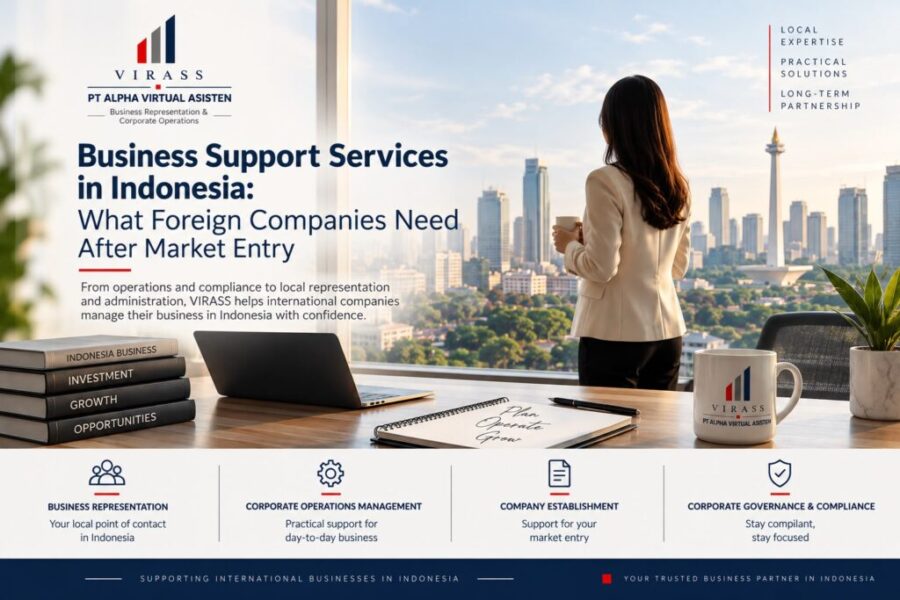
A local business support partner can help international investors coordinate activities in Indonesia and reduce the administrative burden of managing a new market from overseas. Depending on the agreed scope, support may include:
Business representation and local coordination
• Corporate operations support
• Administrative and document coordination
• Meeting, scheduling and follow-up support
• Communication with local stakeholders
• Coordination with legal, accounting, tax and other professional advisers
• Operational reporting and information flow between Indonesia and overseas headquarters
• Support during company establishment and the early stages of local operations
The right partner should understand the investor’s objectives, communicate clearly, maintain confidentiality and know when a matter must be referred to a licensed or specialist professional.
7. Why Administrative Support Matters to Investors
Administrative work can appear routine, but delays or incomplete follow-up may affect business relationships, internal decision-making and operational continuity. Reliable support can help investors maintain organized records, coordinate meetings, track action items and keep communication moving between local teams and overseas management.
For smaller companies, this support may reduce the need to immediately build a large local back-office team. For larger organizations, it may complement existing staff by providing additional coordination capacity during market entry, project implementation or periods of expansion.
8. From Initial Investment to Sustainable Operations
Foreign investment should be viewed as a long-term operating commitment rather than a one-time establishment project. After entering Indonesia, investors should regularly review performance, compliance responsibilities, staffing needs, partner relationships, administrative processes and future expansion plans.
A practical operating framework should clarify responsibilities between the overseas headquarters, local management, internal employees, external advisers and business support providers. This helps prevent duplicated work, unclear accountability and communication gaps.
9. Questions Foreign Investors Should Ask Before Choosing a Local Partner
- Does the partner understand our business objectives and industry?
- Can the partner explain its scope of responsibility clearly?
- Which activities are handled directly and which require external professional advisers?
- How will confidential information and company documents be managed?
- How frequently will we receive updates and operational reports?
- Can the partner support us beyond initial establishment?
- Does the partner have a practical understanding of communication across cultures and time zones?
Conclusion
Foreign investment in Indonesia can create meaningful opportunities, but entering the market requires careful planning and reliable local execution. Investors should assess the market, select an appropriate structure, understand company establishment requirements and prepare for ongoing corporate operations.
VIRASS supports international companies with business representation, corporate operations and local business coordination in Indonesia. Depending on the company’s needs, operational functions may include administrative support, document management, scheduling, reporting and coordination performed by internal staff, external professionals or virtual assistants.
Are you considering investing in Indonesia or establishing a local business presence? Contact VIRASS to discuss how we can support your business representation, corporate operations and local coordination needs.
Frequently Asked Questions
Q: What is foreign investment in Indonesia?
A: Foreign investment refers to capital or business participation from investors based outside Indonesia. The applicable structure and requirements depend on the investor’s activities, ownership and sector.
Q: Do foreign investors need to establish a company in Indonesia?
A: Not every investor will require the same structure. The appropriate approach depends on the intended activities, duration, sector and level of local presence. Professional advice should be obtained before making a decision.
Q: What support do foreign companies need after entering Indonesia?
A: Common needs include corporate administration, document coordination, reporting, stakeholder communication, scheduling, local follow-up and operational support.
Q: Is virtual assistance part of corporate operations?
A: Yes. Virtual assistance may support administrative and coordination functions such as scheduling, correspondence, document preparation, reporting and follow-up. It is one operational function rather than the overall definition of corporate operations.
Q: How can VIRASS support foreign investors?
A: VIRASS can support international companies through business representation, corporate operations and local business coordination, while coordinating with appropriate professional advisers when specialist services are required.