
How European Companies Can Expand Into Indonesia
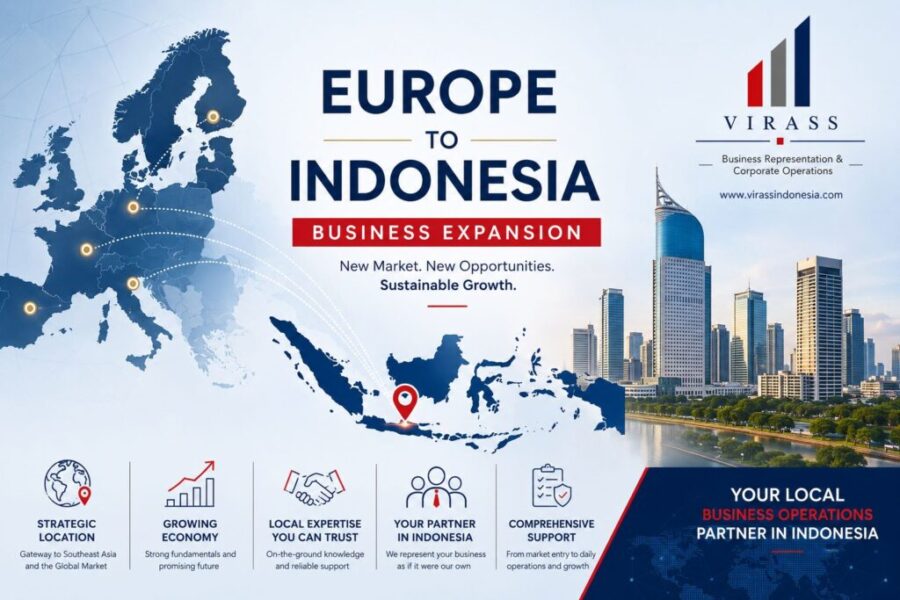
For many European companies, Indonesia represents an attractive opportunity to expand into Southeast Asia.
The country offers access to a large domestic market, a strategic position within ASEAN, a growing investment environment and opportunities across a wide range of industries.
At the same time, expanding into Indonesia requires more than identifying a market opportunity.
European companies entering Indonesia need to understand the local business environment, corporate requirements, administrative processes, stakeholder relationships and the practical realities of managing operations locally.
This is where having the right local business partner in Indonesia can make a significant difference.
Why European Companies Are Looking at Indonesia
Indonesia is the largest economy in Southeast Asia and has become increasingly relevant to international companies looking to establish a presence in the region.
The relationship between the European Union and Indonesia is also developing further. For European businesses, this creates opportunities not only for direct investment but also for establishing local operations, developing partnerships and accessing the wider Southeast Asian market.
However, opportunity alone does not guarantee successful market entry.
The challenge is often how to enter the market correctly and how to operate effectively after entering.
1. Understand the Indonesian Market Before Entering
One of the first steps for a European company considering Indonesia is understanding how the local market differs from its home market.
Business practices, decision-making processes, government administration, stakeholder relationships and commercial expectations can be different.
A market-entry strategy should therefore consider:
- Target customers and market demand
- Local competitors
- Business partners and suppliers
- Corporate structure
- Regulatory requirements
- Licensing and administrative processes
- Local staffing requirements
- Operational costs
- Tax and accounting coordination
- Communication and cultural differences
Understanding these factors early can help companies avoid unnecessary delays and costly mistakes.
2. Decide How You Want to Establish Your Presence
Not every European company entering Indonesia needs the same structure.
Depending on its objectives, a company may consider different approaches, including:
- Establishing an Indonesian company
- Working with a local business partner
- Appointing a local representative
- Establishing local corporate operations
- Developing a commercial partnership
- Using outsourced operational support
The right structure depends on the company’s business model, investment plans and long-term objectives.
3. Why Local Business Representation Matters
A European management team may understand its own business extremely well but still face challenges when dealing with the Indonesian market remotely.
A local business representative can act as a practical bridge between the international management team and local stakeholders.
Depending on the engagement, local representation may include:
- Local business communication
- Stakeholder coordination
- Business meeting representation
- Vendor and partner coordination
- Government and administrative coordination
- Local market communication
- Follow-up of operational matters
- Reporting to international management
The objective is not simply to have someone on the ground. The objective is to have a reliable local point of contact who understands the company’s objectives and can help translate them into practical local execution.
4. Entering Indonesia Is Only the Beginning
One common mistake is to focus entirely on company establishment and overlook what happens afterward.
Once a company begins operating in Indonesia, it may need ongoing support with:
- Corporate administration
- Documentation
- Vendor coordination
- HR administration
- Finance and accounting coordination
- Operational reporting
- Stakeholder communication
- Regulatory and compliance coordination
- Local business development
- Day-to-day operational matters
This is where corporate operations support in Indonesia can become valuable.
5. Corporate Compliance and Local Requirements
Indonesia has its own corporate, administrative and regulatory environment.
European companies should therefore ensure that their Indonesian operations are properly coordinated and that important corporate obligations are not overlooked.
Areas that may require ongoing attention include:
- Corporate documentation
- Regulatory requirements
- Corporate governance
- Reporting
- Licensing coordination
- Tax and accounting coordination
- Employment administration
- Government correspondence
- Corporate records
Professional local coordination can help international management maintain better visibility over these matters.
Important: Specific legal, tax, accounting and licensing matters should be handled by the appropriate licensed professionals or authorities. A business support partner can coordinate these processes without replacing regulated professional services.
6. Indonesia Can Be More Effective With the Right Local Partner
For a European company, having a local partner is not necessarily about outsourcing everything.
It can be about creating a reliable connection between European Management → Indonesia Operations → Local Stakeholders.
A strong local business partner can help coordinate communication, follow up on operational matters and provide management with clearer visibility of what is happening locally.
This can allow the international management team to focus on business strategy, customers, investment, product development and international growth while local operational matters are handled and coordinated in Indonesia.
7. A Practical Market Entry Framework
European companies considering Indonesia can use a simple five-step approach:
Step 1 — Assess: Understand the market, opportunities, competitors and requirements.
Step 2 — Plan: Determine the appropriate business structure and operational model.
Step 3 — Establish: Coordinate the required company setup, documentation and local arrangements.
Step 4 — Operate: Manage local administration, stakeholders and day-to-day business operations.
Step 5 — Grow: Develop the local business while maintaining proper corporate governance and operational control.
This approach helps companies look beyond “How do I establish a company in Indonesia?”
The more important question is: “How will I operate my business successfully in Indonesia after establishment?”
8. Why European Companies May Benefit From Local Support
For international businesses, local support can reduce the distance between headquarters and Indonesia operations.
Local presence — A reliable point of contact in Indonesia.
Operational coordination — Follow-up of local business and administrative matters.
Communication — A bridge between international management and local stakeholders.
Business representation — Support when the company’s management cannot be physically present.
Corporate operations support — Assistance coordinating ongoing operational requirements.
Local knowledge — Practical understanding of how business is conducted in Indonesia.
The exact scope can be tailored according to the company’s needs.
9. Indonesia as a Long-Term Business Opportunity
Indonesia should not necessarily be viewed only as a short-term market-entry opportunity.
For companies with a long-term strategy, establishing reliable local operations can create a stronger foundation for growth.
Indonesia’s investment environment remains active, and the country’s growing relationship with European markets creates additional relevance for companies considering Southeast Asian expansion.
For European businesses, the opportunity is not only to enter Indonesia, but to build a sustainable and properly managed local presence.
10. Choosing the Right Local Business Partner
Does the partner understand international businesses? Local knowledge is important, but international communication and reporting standards are equally important.
Can they provide one point of contact? Having one reliable person coordinating multiple local matters can simplify communication.
Do they understand operational realities? Market entry is only the first step. Ongoing operational support matters just as much.
Can they coordinate with professional providers? A good business support partner should know when matters need to be handled by lawyers, tax advisers, accountants, notaries or government authorities.
Can they provide transparent reporting? International management needs clear information about what has been done, what remains outstanding and what requires a decision.
Conclusion
Indonesia offers significant opportunities for European companies seeking to expand into Southeast Asia.
But successful expansion requires more than establishing a company.
It requires a clear market-entry strategy, reliable local representation, effective corporate operations, proper coordination and an understanding of the Indonesian business environment.
For European companies entering Indonesia for the first time, the right local business partner can provide an important bridge between international strategy and local execution.
At VIRASS, we support international companies with Business Representation, Corporate Operations Management, Company Establishment Coordination, and Corporate Governance & Compliance support in Indonesia.
Our role is to become a practical local extension of your business — helping you establish, coordinate, manage and grow your presence in Indonesia.
If your company is considering entering or expanding into Indonesia, contact VIRASS to discuss how we can support your local business presence and operations.
VIRASS Indonesia
Your Trusted Business Partner in Indonesia
Frequently Asked Questions
Do European companies need a local business partner in Indonesia?
Not necessarily, but local support can help international companies understand the Indonesian business environment, coordinate local matters and maintain communication with stakeholders.
Can a European company operate in Indonesia without establishing a local company?
The appropriate structure depends on the company’s activities, objectives and applicable Indonesian requirements. Companies should obtain professional advice before deciding on their structure.
What does a business representative do in Indonesia?
A business representative may help with local communication, stakeholder coordination, business meetings, partner coordination and other agreed local activities.
What support do foreign companies need after establishing a company in Indonesia?
Ongoing needs can include corporate administration, operational coordination, documentation, stakeholder communication, HR administration, finance coordination and compliance coordination.
How can a European company find a reliable business partner in Indonesia?
Companies should evaluate the partner’s local experience, international communication capability, transparency, reporting practices, professional network and ability to coordinate ongoing operations.